Physical Therapy in Costa Mesa: A Complete Guide to Recovery and Performance for Athletes and Active Adults
If you train hard, compete, or simply love staying active, an injury can feel like a door slamming shut. Maybe you are dealing with an ACL tear, a nagging hamstring strain, or a shoulder that aches every time you reach overhead. Maybe you have been told to rest, then felt the same pain return the moment you got back to your routine.
That frustration is real, and you are not alone in it. The right physical therapy in Costa Mesa should do more than quiet your symptoms. It should identify why your body broke down, rebuild it properly, and prepare you to perform again.
This guide walks you through what physical therapy can do for you, the conditions it addresses, how testing and treatment work, and what to look for in a clinic. It also shows how Community Physical Therapy & Performance approaches care for athletes and active adults across Costa Mesa.
What Physical Therapy Can Do for You
Physical therapy is a healthcare approach focused on restoring movement, reducing pain, and improving how your body functions. Physical therapists examine how you move, diagnose movement problems, and build a plan to improve mobility, strength, and function.
Many people think physical therapy is only for after surgery or a major injury. In reality, it also plays a meaningful role in managing ongoing pain, preventing future injuries, and improving physical performance.
A strong physical therapy plan typically helps you:
Understand what is causing your pain or limitation
Restore motion, strength, and neuromuscular control
Return to work, sport, or daily life with confidence
Lower your risk of the same injury happening again
For competitive athletes, the goal is often bigger than feeling better. You want to return to your sport at a higher level than before. That takes a plan that blends rehabilitation with strength and conditioning, which is the foundation of the work at Community Physical Therapy & Performance.

Who Benefits From Physical Therapy in Costa Mesa
Costa Mesa is an active community. Between club and collegiate sports, running routes, gyms, courts, and weekend recreation, people here move a lot. That also means injuries are common across all ages and activity levels.
Competitive Athletes
If you compete at a serious level, you have a different set of needs than the average patient. You need a clinician who understands the demands of your sport and who will not clear you until your body is truly ready.
Athletes often seek care for:
ACL injuries and other knee problems, including meniscus injuries
Hamstring strains, groin pain, and hip impingement (FAI)
Shoulder and elbow pain from throwing, serving, or swinging
Overuse injuries and tendon problems that keep returning
Concussion symptoms that affect training and daily life
The clinicians at Community Physical Therapy & Performance have worked with elite and professional athletes from the NFL, ATP Tour, FIFA Women's World Cup, USA Badminton, professional boxing, and USL. That experience shapes how every athlete is cared for, from a high school standout to a seasoned pro.
Active Adults Who Want to Move Without Pain
You do not have to be a professional athlete to deserve expert care. If back pain limits your workouts, knee pain slows your runs, or stiffness keeps you from enjoying daily activities, physical therapy can help.
Active adults commonly seek care for low back pain, neck pain, sciatica, plantar fasciitis, shoulder pain, and arthritis-related stiffness. Community Physical Therapy & Performance also supports people working to rebuild strength and muscle as they age, as well as desk workers looking for help with posture and ergonomics.
Young Athletes and Growing Bodies
Growing athletes face their own set of challenges. Conditions such as Osgood-Schlatter disease, Sever's disease, and Little League elbow or shoulder are tied to growth and repetitive stress. Early, appropriate care helps young athletes keep playing while protecting their long-term development.
Conditions Treated at Community Physical Therapy & Performance
The team at Community Physical Therapy & Performance treats a wide range of musculoskeletal and performance-related conditions. Here is how the most common ones are approached.
Knee and Lower Body Injuries
The knee takes a significant beating in sports that involve cutting, jumping, and running. Care is available for ACL injuries, meniscus injuries, runner's knee (patellofemoral pain), IT band syndrome, and general knee pain.
Below and above the knee, treatment also covers:
Ankle sprains
Achilles tendinopathy
Plantar fasciitis and shin splints
Hamstring strains
Hip pain, hip impingement (FAI), and labral tears
Groin pain
The key question is always the same: why did this happen? A sore Achilles may trace back to the hip. A cranky knee may reflect poor force control at the foot. Treating the painful spot alone often leads to the pain returning.
Shoulder, Elbow, and Wrist Problems
Upper body injuries are common in overhead sports, racquet sports, lifting, and desk work. Treatment options include care for shoulder pain, rotator cuff pain or tears, shoulder impingement, frozen shoulder, tennis elbow, golfer's elbow, elbow pain, carpal tunnel symptoms, and wrist pain.
Shoulder and elbow problems often involve more than one joint. The neck, upper back, and shoulder blade all influence how the arm moves, so the entire kinetic chain is evaluated.
Spine and Posture
Back and neck pain can wear you down, especially when it follows you to work and to the gym. The clinic treats low back pain, mid back pain, neck pain, sciatica, postural issues, and scoliosis. Care focuses on restoring movement, building support strength, and teaching you how to load your body well.
Overuse, Tendon, and Age-Related Concerns
Overuse injuries build slowly and often get ignored until they force you to stop. Community Physical Therapy & Performance also treats general tendinopathy, arthritis, and muscle and strength loss (sarcopenia). Guided strength training is an important part of healthy aging and can be built safely into your plan.
What Makes ACL Rehabilitation Different When Performance Matters
An ACL injury is one of the most feared setbacks in sport. The fear of reinjury, the loss of strength, and the uncertainty about your return can weigh heavily on you throughout the process.
Research shows that rehabilitation after ACL injury works best when it is progressive and guided by objective criteria, not just the calendar. Strength, hop performance, movement quality, and psychological readiness all matter when deciding if you are ready to return to sport.
A well-built ACL rehabilitation plan often includes:
Early work on motion, swelling control, and muscle activation
Progressive strength training, including blood flow restriction (BFR) when appropriate
Neuromuscular re-education to retrain control and landing mechanics
Balance and proprioception training
Plyometrics and return-to-sport progressions
Objective testing before clearance
The goal is not only to get you back. It is to get you back stronger and more prepared than you were before the injury.
How Testing Guides Your Recovery
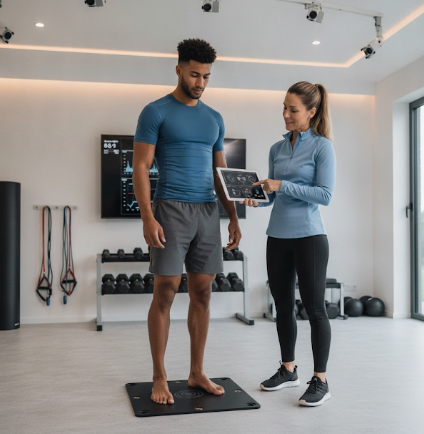
Feeling ready and being ready are not always the same thing. Objective testing removes the guesswork from your recovery and shows exactly where you stand relative to your goals and your uninjured side.
Movement Assessments
A functional movement assessment and movement screen reveal how you squat, lunge, hinge, balance, and move through sport-specific patterns. These tests highlight limits in mobility, stability, or control that may be contributing to your pain or slowing your progress.
Performance and Strength Testing
Testing options at Community Physical Therapy & Performance include:
Force plate testing to measure how you produce and absorb force, assessing power, balance, and left-to-right differences
VALD testing to gather objective data on strength and performance
Isokinetic and dynamometer testing to measure muscle strength and detect imbalances
Return-to-sport testing to confirm you meet performance benchmarks before returning to full competition
This data shapes your plan, tracks your progress, and supports clear decisions about when you are ready for the next stage. It also gives you something concrete to point to as you rebuild trust in your body.
Treatments and Techniques Used in Your Care
No single technique fixes every problem. Community Physical Therapy & Performance combines hands-on care with exercise and performance training based on what your evaluation reveals.
Hands-On Manual Therapy
Manual therapy helps reduce pain, improve motion, and prepare your body for exercise. Depending on your needs, care may include:
Joint mobilization and manipulation
Myofascial release and soft tissue mobilization
Trigger point therapy
Graston and IASTM (instrument-assisted soft tissue mobilization) and scraping
Cupping
Assisted stretching and massage therapy
Taping, including KT and athletic taping
These techniques create a window of improved movement and reduced pain that is then used to build lasting change through exercise.
Exercise and Performance Training
Exercise is the core of most successful rehabilitation programs. Because the clinicians at Community Physical Therapy & Performance are trained in both physical therapy and strength and conditioning, your program can move smoothly from rehabilitation to performance training without changing providers.
This may include therapeutic exercise, resistance training, mobility work, balance and proprioception training, neuromuscular re-education, plyometrics, and breathwork or diaphragmatic training. Blood flow restriction (BFR) training can be particularly useful when heavy loading is not yet appropriate, such as early after surgery or during painful phases.
Recovery Support
When appropriate, the team may also incorporate compression therapy (such as Normatec) and electrical stimulation (TENS or NMES). These modalities support recovery, pain management, and muscle activation as part of a broader program.
What to Expect When You Start Physical Therapy
Starting care can feel uncertain, especially if you have already tried other options without lasting success. Here is what your experience looks like at Community Physical Therapy & Performance.
A Free Discovery Call
Before you commit to anything, you can book a free discovery call. You can share your story, ask questions, and find out whether the approach fits your goals.
A 60-Minute Comprehensive Evaluation
Your first visit is a full hour with a Doctor of Physical Therapy. Your history, sport or activity, goals, and past care are all reviewed. Movement, strength, and areas of pain are then examined, with testing incorporated when appropriate. By the end, you should understand what is going on, why it is happening, and what the plan is.
60-Minute One-on-One Treatment Sessions
Follow-up sessions are also 60 minutes and always one-on-one with your Doctor of Physical Therapy. You will not be handed off to an aide or an assistant. Each session is built around you, adjusted in real time, and focused on steady progress.
Progression to Performance
As your pain settles and your function improves, your plan shifts toward strength, power, speed, and sport-specific demands. For athletes, that means working toward return-to-sport testing and full competition readiness. For active adults, it means building the strength and resilience to stay active for the long run.
Why Choose Community Physical Therapy & Performance in Costa Mesa
Choosing a clinic is a personal decision, and you deserve to know what sets one apart.
One-on-One Care With a Doctor of Physical Therapy
Every minute of your visit is spent with a Doctor of Physical Therapy. This continuity helps the clinician catch small changes, adjust quickly, and keep your plan on track.
A Root-Cause Approach
Pain is a signal, not always the source. The team looks for the underlying cause of your symptoms so your results hold up under the demands of training, competition, and daily life.
Credentials and Experience You Can Trust
Clinicians at Community Physical Therapy & Performance hold doctorate-level credentials from USC and are Board Certified Orthopedic Clinical Specialists. Their experience includes work with elite and professional athletes across multiple sports, and that knowledge benefits every patient who walks through the doors. You can learn more on the About page.
Dual Expertise in Rehabilitation and Performance
Many clinics stop at pain relief. At Community Physical Therapy & Performance, that is only the first step. By combining physical therapy with strength and conditioning, the team can carry you from injury to peak performance without requiring you to change providers or start over.
How to Choose the Right Physical Therapist for Your Goals
Whether you choose Community Physical Therapy & Performance or another clinic, a few questions can help you find the right fit:
How much time will I spend with the clinician? Longer, focused sessions allow for better assessment and treatment.
Who will treat me? Confirm whether you will see a licensed physical therapist or support staff.
Do they look for the cause of my problem? A quality clinic explains why you are hurting, not just what hurts.
How do they decide when I am ready to return? Objective testing is a strong indicator of quality care.
Do they understand my sport or activity? Experience with athletes matters, especially at higher levels of competition.
Do they help me beyond pain relief? Look for a plan that includes strength and performance goals.
A clinic that welcomes these questions is usually one that is confident in its care.
Take the Next Step Toward Recovery and Performance
If pain or injury is holding you back, you do not have to keep guessing or waiting. Expert, individualized care can help you understand what is going on and give you a clear path forward.
Community Physical Therapy & Performance is here to guide you, whether you are returning from an ACL injury, working through an overuse problem, or simply want to move without pain again. Book your free discovery call today to talk about your goals, then start your 60-minute evaluation with a Doctor of Physical Therapy who will focus entirely on you. Explore the full list of services or visit the home page to get started.